Friday, March 15, 2024

Vote now! Reward the outstanding free services offered by the Digital Agri Hub to support the transformation of the agricultural sector


The Digital Agri Hub run by the Wageningen University and Research (WUR) has been nominated as a potential candidate awardee for the UN / ITU WSIS 2024 prize in the Category 13 - AL C7 E-agriculture

The Hub offers free access to a dashboard with over 1200 digital solutions for agriculture in low- and middle-income countries (LMICs) and to digital communities hosted on community platforms. 

The winners of the WSIS 2024 prizes will be selected based on the result of a public voting process.

How to vote:
  • Only registered members of the WSIS Stocktaking Platform (STK) with requested complete information may vote for/appreciate a project. The information should contain organization details: name, type, country and user details: username and e-mail.
  • Members may only vote for one project in each category 
  • Voters are encouraged but not required to cast votes for one project in each of categories.
Voting – step by step (for new STK members):
  1. Register https://www.itu.int/net4/wsis/stocktaking/Account/ 
  2. Confirm your registration via the confirmation email you will have received in your inbox
  3. Login
  4. Select Prizes on the top navigation bar.
  5. Select “Vote” > “Vote ->”
  6. Select: “Voting form”
  7. Select: AL C7. E-agriculture on the drop-down menu.
  8. Scroll down, look for Digital Agri Hub and click on “Vote for this Project
  9. Optional: Select other categories of your interest and express your preferences as well.

Voting – step by step (for already registered STK members)
  1. Follow this link: https://www.itu.int/net4/wsis/stocktaking/Prizes/2024 
  2. Select “Vote” > “Vote ->”
  3. Login
  4. Select: “Voting form”
  5. Select: AL C7. E-agriculture on the drop-down menu.
  6. Scroll down, look for Digital Agri Hub and click on “Vote for this Project
  7. Optional: Select other categories of your interest and express your preferences as well.


Tuesday, June 20, 2023

Developing Institutions and Inter-Organizational Synergies through Digitalization and Youth Engagement in African Agriculture: The Case of “Africa Goes Digital”

As digitalization increasingly gains attention in the agriculture sector, many African youths are seizing the opportunity provided by digital technologies to engage in agriculture. 

While prior studies have started examining the intricacies of digitalization in agriculture, they have paid less attention to its implications for fostering institutions and inter-organizational synergies that can support and sustain the businesses of youth enterprises engaging with Africa’s agriculture. Against this backdrop, the authors undertook a qualitative case study to shed light on the development of a community of practice comprising youth enterprises engaging in agriculture through digitalization. Thus, they studied Africa Goes Digital (AFGD), a consortium of young African enterprises that rely on digital technologies and solutions to provide services to farmers across the African continent. 

Africa Goes Digital - Transforming Africa into #TheAfricaWeWant from Federico Rambaldi on Vimeo.

The results showed that: (1) the Technical Centre for Agricultural and Rural Cooperation ACP-EU (CTA) played a pioneering role as a development agency in supporting enterprises with drones and training for agriculture, which led to the formation of AFGD; (2) two prevalent themes characterized the services offered by AFGD members; (3) AFGD brings members under one platform where they leverage WhatsApp for communication and knowledge sharing and Twitter to showcase success stories and form partnerships with each other to execute certain development projects with governments and development agencies; (4) the lack of regulations or the restrictive regulations on the use of drones are still problems that some members face, and the high costs of sensors and related drones are challenges for the members. 

Building on the results, the authors discuss the implications of digitalization for supporting African governments in meeting sustainability goals and conclude by describing the theoretical contribution of their study and promising future research directions.

Authors: Matthew Ayamga , Abdelaziz Lawani, Selorm Akaba and Arsene Birindwa

Read and download the full article.

Friday, April 14, 2023

Is gender inclusion in the framework of D4Ag projects a genuine need based on objective assessments, or an indispensable component to satisfy donors’ expectations? | Join the e-conversation on Starting on Monday 17 April, 2023

Digital technologies and solutions are increasingly important in revolutionizing agriculture food systems in low- and middle-income countries (LMICs). The drive towards promoting digitalization for agriculture (D4Ag) among small-scale producers in LMICs is relentless. Therefore, it is crucial to take a factual, objective, and measured approach to identify and possibly overcome potential stereotypes.

On Monday 17 April, the Digital Agri Hub is launching the 4th of a series of e-conversations on what it considers as potential clichés in the D4Ag domain.  The exchanges are hosted on the Digitalisation for Agriculture or D4Ag dgroup which you are welcome to join.

The outcome of the exchanges may lead to a more objective, prudent and realistic attitude on how to approach and present gender inclusion in D4Ag projects in LMICs. It can also open new avenues which could help solving issues that are at the basis of potential stereotypes.

The 3rd e-conversation on whether “smart farming is raising justifiable expectations” has come to an end, and its summary is now available on the D4Ag dgroup’s wiki (login required) or on The Hub events’ page.

The forthcoming e-conversation Starting on Monday 17 April, 2023, will address the following question: “Is gender inclusion in the framework of D4Ag projects a genuine need based on objective assessments, or an indispensable component to satisfy donors’ expectations?

Each e-conversation topic is well framed via an initial message posted on the D4Ag group to kickstart the reflections. The subsequent topic will be launched once the exchanges about the preceding one are completed, and so on. Summaries of the exchanges are shared.

Join the conversation -> https://bit.ly/dGp4A


Saamaka People in Suriname suffer from illegal logging within their land


Stand with the Saamakans from Federico Rambaldi on Vimeo.

In this video, the Saamaka communities in Suriname ask the international community to stand with them to defend their land against intrusive Forest destructive activities and to demand that the Suriname government grants legal recognition of Saamaka ancestral rights to the land.

The Saamaka tribe is an Afro-descendant community that has inhabited the Suriname river watershed for over 300 years. They have a deep spiritual and cultural connection with the land and have preserved it through their customary laws and traditions.

However, over the past 30 years, Saamaka communities have struggled to defend their land against intrusive logging and gold mining activities. In the 1990s, the Government of Suriname granted logging concessions to multinationals in their territory without consulting them. For almost a decade, the forest was exploited, causing the destruction of agriculture fields and pollution of drinking water sources.

In the year 2000, the Saamaka decided to stand up and defend their territory against these threats and fights for the legal recognition of their land rights. They organized themselves into the Association of Saamaka Authorities and filed a petition to the Inter-American Court of Human Rights. The petition asked for support to stop human and land rights violations in their territory. This led in November 2007, to the issuance of a binding judgement by the Inter-American Court of Human Rights in favor of the Saamaka people, known as ‘Saamaka judgement’. It required the State of Suriname to legally recognize their land rights and stop any logging and infrastructure development inside the Saamaka territory and fully apply Free Prior Informed Consent procedures.

However, 15 years have passed since the ruling of the court, and the Government of Suriname still does not comply with the Saamaka judgment. On the contrary, their land rights are still not legally recognized, and logging concessions continue being granted without Free Prior Informed Consent.

Moreover, the issuance of community forest concessions is another violation of Saamaka rights. These areas, granted to individuals from the communities, are presented by the government as a way to legitimate Saamaka people's rights to the forest. However, in practice, these forest concessions delegitimize and violate Saamaka communal systems of property, creating internal conflicts, elite capture, and internal corruption.

Since one year ago, Saamaka communities have been struggling again to protect their land against a new destructive intrusion. A logging company has gained access to their concession on the east side of the Saamaka territory. Despite opposition from the Association of Saamaka Authorities, the logging company, with the support of few Saamaka individuals, who disregard the community’s stand, has built a pontoon to mobilize heavy machinery across the river and has begun road work without obtaining the Saamaka’s Free Prior Informed Consent.  As a result of this access, thousands of valuable logs are exploited illegally. This road poses now a significant threat to the livelihoods and sustainable use of forest resources maintained by the Saamaka. More importantly, the forest itself has customary and spiritual value for them. The road would facilitate access for illegal gold miners and more loggers, causing widespread habitat destruction.

With human and recurrent land rights’ violations, the Saamaka people are taking fresh action to advocate for the legal recognition of their ancestral land rights and demand that the Government of Suriname fully complies with the ‘Saamaka judgment’. 

As stewards of more than one million hectares of tropical rainforest, the Saamaka people ask the international community to support their efforts to protect their land.


Friday, March 31, 2023

Friday, March 10, 2023


Saturday, February 25, 2023

Your welcome contribution to forthcoming e-conversations on controversial issues related to #digitalisation for #agriculture, #aquaculture, #mariculture, and more


Tuesday, December 14, 2021

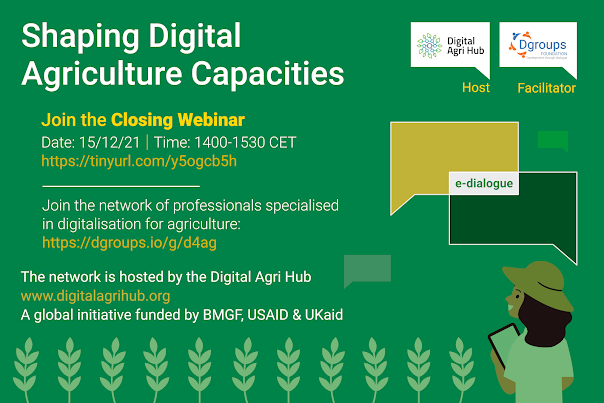
Closing #webinar | #D4Ag online dialogue on shaping digital agriculture capacities | Wed 15/12/21 @ 2PM-3:30PM CET


Over the past three weeks, the Digital Agri Hub with the support of the Dgroups Foundation, has been hosting an online dialogue to identify capacity opportunities, gaps, priority needs and best-bet learning solutions for people and organizations working with digital agriculture.

Specifically, at the dialogue kick-off webinar and in the subsequent email-based exchanges, dialogue’s participants have been pinning down the perceived capacity needs of three stakeholder groups - implementers (extension services, farmers organisations, NGOs, etc.); enablers (policy makers,  government and international organisations, etc.); and D4Ag service / solution providers (organisations or individuals providing services in the domain of digitalisation for agriculture, including innovations and data infrastructure).

Are you curious to know what emerged from this dialogue? Do you want to know more and add your voice and ideas to the dialogue outcomes and results?
 

Join us for the D4Ag dialogue closing webinar on 15 December and contribute to shape and deliver digital agriculture capacities for the future!

Register here >> https://us02web.zoom.us/meeting/register/tZYqc-Ggrj8vEtG9ThuSg45tGo9bSaBlUByL


Tuesday, November 30, 2021

Landscaping the Agritech Ecosystem for Smallholder Farmers in Latin America and the Caribbean.

 Promotional video for the report “Landscaping the Agritech Ecosystem for Smallholder Farmers in Latin America and the Caribbean.” Based on the review of 131 digital agriculture tools, this report, prepared by GSMA and IDB Lab, provides a market mapping and landscape analysis of the most prominent cases of digital disruption. It highlights some of the major trends observed in five digital agriculture use cases, identifies opportunities for digital interventions, and concludes with recommendations for future engagement that could deliver long-term, sustainable economic and social benefits for smallholder farmers.


Monday, November 15, 2021

Shaping digital agriculture capacities - A D4Ag online dialogue - Zoom Kick-off session on Friday 19 Nov 2021 from 1400 - 1530 CET

Do you work with digital technologies, innovations or data to deliver and transform agriculture and food systems?

Join a global network of 1,200 people to help shape future investments in digital agriculture (#D4Ag) capacities


From 19 November to 10 December, the
Digital Agri Hub’s online D4Ag dialogue aims to identify capacity gaps, opportunities, priority needs and best-bet learning solutions for people and organizations working with digital agriculture. Supported by the Dgroups Foundation, the online dialogue combines two virtual (Zoom) sessions with email based, facilitated discussions, in a rich and dynamic process.

Join us on Zoom for the dialogue kick-off session on 19 November 2021 from 1400 – 1530 CET:

  • Learn about the dialogue and how to participate 
  • Meet other D4Ag professionals
  • See what capacity building initiatives already exist 
  • Together, start to shape and deliver digital agriculture capacities for the future!

Register here >> https://us02web.zoom.us/meeting/register/tZ0rf-mhrTojHtLHKxHT3pdKq7jmOaJjUkB6

Wednesday, July 28, 2021

Developing a policy framework for adoption and management of drones for agriculture in Africa

Developing a policy framework for adoption and management of drones for agriculture in Africa


This paper proposes a drone policy framework for developing drone regulations for Africa, expediting the individual countries’ developing drone regulations. This research was conducted following concerns raised by individuals and businesses whose imported drones were seized by customs or had to go through a cumbersome process for approval to use drones for lack of regulations. To derive the policy framework, we matched the provisions of 15 existing drone regulations from Africa to the International Civil Aviation Organization (ICAO) Manual on Remotely Piloted Aircraft Systems (RPAS) using a decomposition modelling technique. The proposed framework is presented as a formal business process model and is evaluated in a multi-case study approach in two different case studies. 

The results indicate that two key aspects/elements are crucial in the development of a drone framework and thus are included in our framework: (i) stakeholders’ inclusion in the policy development and (ii) regulators liaising with security agencies like the police and immigration officials to implement and enforce developed regulations. 

Applying the proposed framework in describing existing regulations reveals that 40-85% of provisions in existing regulations conform to the provisions in ICAO’s RPAS manual.

Citation:

Matthew Ayamga, Bedir Tekinerdogan, Ayalew Kassahun & Giacomo Rambaldi (2021) Developing a policy framework for adoption and management of drones for agriculture in Africa, Technology Analysis & Strategic Management, 33:8, 970-987, DOI: 10.1080/09537325.2020.1858047

Interested in drone technology? Join the community www.uav4ag.org 

Monday, January 20, 2020

Sommet mondial sur la société de l'information (SMSI) - Prix 2020 : la phase de vote s'achève le 24 janvier 2020.

Sommet mondial sur la société de l'information (SMSI) - Prix 2020 : la phase de vote s'achève le 24 janvier 2020 https://www.itu.int/net4/wsis/stocktaking/Prizes/2020/Vote

Le projet : « Transformer l'agriculture africaine - Les yeux dans le ciel pour des technologies intelligentes au sol » ou « Eyes in the Sky, Smart Techs on the Ground » en anglais a été nominé dans la catégorie AL C7. E-agriculture.


Au total, 20 projets ont été nominés dans cette catégorie. Les cinq premiers ayant reçu plus de votes seront sélectionnés pour une évaluation plus approfondie.

Pour voter, vous devez être inscrit sur la plate-forme d'inventaire du SMSI. Vous pouvez exprimer un vote par catégorie et voter pour une ou plusieurs catégories. Le site hébergeant la plateforme de vote n'est pas aussi simple qu'il devrait l'être et il est assez difficile de s'y retrouver.

POUR VOTER, SUIVEZ LES ETAPES SUIVANTES :

  1. Inscrivez-vous
  2. Connectez-vous en tant qu'utilisateur inscrit
  3. Cliquez sur le lien suivant : https://www.itu.int/net4/wsis/stocktaking/Prizes/2020/Vote?jts=P4W9PG&id=10&page=13#start qui vous mènera directement vers la catégorie AL C7. E-agriculture. 

Le projet "Eyes in the Sky, Smart Techs on the Ground" est répertorié dans cette catégorie.

Cliquez sur... more >> et lisez la description détaillée du projet et de ses réalisations.

Exprimez votre préférence et votez. Nous comptons sur votre bon jugement. 


Sunday, December 29, 2019

World Summit on the Information Society - Prizes 2020: the voting phase comes to an end on January 24, 2020

World Summit on the Information Society - Prizes 2020: the voting phase ends on January 24, 2020. Vote Now!

The project: "Eyes in the Sky, Smart Techs on the Ground: Transforming Africa's Agriculture " has been nominated for voting under the category AL C7. E-agriculture.


A total of 20 projects have been nominated in this category. The first five most voted will be selected for further evaluation. In order to vote, you need to be registered on the WSIS Stocktaking Platform. You can express one vote per category and vote for one or more categories. The site hosting the voting platform is not as straight forward as it should be, and it is quite difficult to navigate. 


Follow these steps (recommended):

  1. Register
  2. Login as a registered user
  3. Follow this link: https://www.itu.int/net4/wsis/stocktaking/Prizes/2020/Vote?jts=P4W9PG&id=10&page=13#start which will lead you straight to the category AL C7. E-agriculture.

The project "Eyes in the Sky, Smart Techs on the Ground" is listed under this category 

Click on  ... more>> and read the retailed description of the project and its achievements. 

Express your preference and vote. We rely on you good judgement.

Wednesday, July 3, 2019

The Digitalisation of African Agriculture Report, 2018-2019 - available for download

At CTA, we know and understand the power to digitalise African agriculture. But we also understand that the evidence that will attract targeted investments to further develop D4Ag on the continent is lacking.

We realised that it is time to chart the scale of the opportunity and make some projections that will help in guiding policy and investment decisions. It is why we have produced a report together with Dalberg Advisors and supported by a high-level Advisory Council bringing together the key stakeholders that have been engaged in the space. The report is the first attempt to consolidate evidence and provide proof of impacts and the knowledge that will allow evidence-based investments.

While, in the report, we find a young sector, it’s clear that the appetite for D4Ag is burgeoning. However, without the right policy focus and investment there is a danger that the development will be piecemeal, neither sustainable nor inclusive. To capitalise on this opportunity we need to ensure that development is coordinated, that best-practices are shared and a collaborative approach to rolling out and scaling-up digital innovation, primarily focused on increasing use by farmers, is adopted.

 This report is a valuable first step, we have seen an appetite to continually improve our understanding of the D4Ag landscape and chart the opportunity it offers for entrepreneurs, investors and governments. I hope our efforts will be valuable in guiding the opportunity and look forward to the collaborative push that I believe will bring D4Ag to life for the benefit of Africa’s smallholder farmers and food and nutrition security across the continent. And as long as we learn from lessons, do it right and manage risks and take into account data sovereignty, inclusivity, sustainability, we will all benefit.”  Michael Hailu, CTA Director"

This report realises that there is great appetite for D4Ag and that policy mechanism should be invested in to guide the implementation of digital solutions. The value of collaborative approach that is focusing on increasing use of technologies by farmers is encouraged.


Friday, June 8, 2018

Landmark Pan-African Policy Recommendation Singles out Drones as a Transformative Technology for Africa


On June 8, 2018, a full report on the technology entitled “Drones on the horizon: Transforming Africa’s Agriculture” has been launched by Prof Yaye Kène-Gassama Dia, from the University Cheikh Anta Diop Dakar, on behalf of the High-Level Panel on Emerging Technologies (APET) and NEPAD during the Africa Innovation Summit which took place in Kigali, Rwanda. 


The African Union singled out Unmanned Aerial Vehicles (UAV) also known as drones, as a disruptive technology which could impact the development of agriculture on the African continent. On 26 January 2018, by issuing Decision  EX. CL/Dec. 986-1007 (XXXII), the AU Executive Council recommended that all Member States harness the opportunities offered by drones for agriculture.

"Precision agriculture-drone nexus is seen as enhancing the socio-economic well-being of Africa and is likely to support African states in the attainment of the Sustainable Development Goals (SDGs) and specifically SDGs 1 and 2 Prof Yaye Kène-Gassama Dia"stated.

The report, available in English and French, is a high-level recommendation by the AU to Member States to support and facilitate the deployment of drone technology in agriculture.

More on the launch of the report :